
Collection: Chinese Wedding Tea Sets
12 products
-
Double Happiness Red Wedding Tea Set
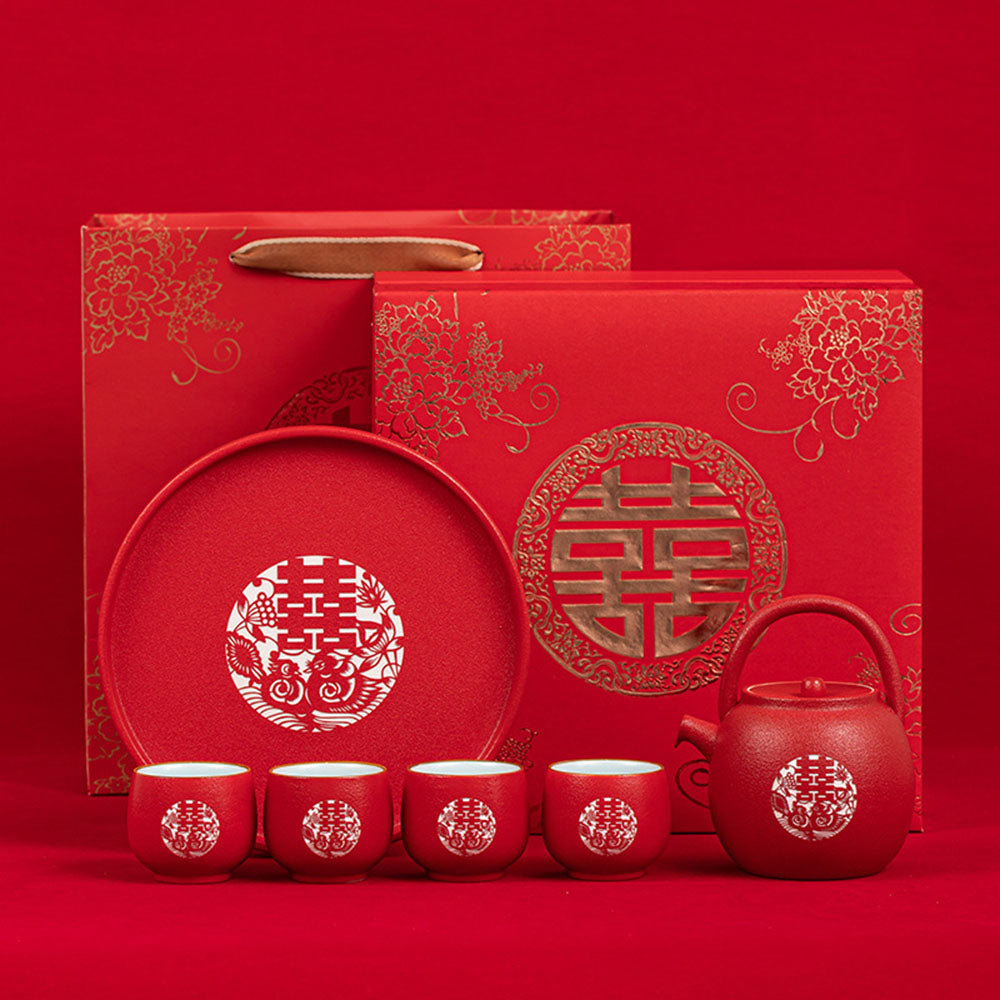 Vendor:Double Happiness Red Wedding Tea SetUmi Tea Sets
- Regular price
-
$99.98 USD - Regular price
-
- Sale price
-
$99.98 USD
Quick view
-
Chinese Wedding Teapot With Four Gaiwan
 Vendor:Chinese Wedding Teapot With Four GaiwanUmi Tea Sets
- Regular price
-
$106.45 USD - Regular price
-
- Sale price
-
$106.45 USD
Quick view
-
Double Happiness Lines Wedding Tea Set
 Vendor:Double Happiness Lines Wedding Tea SetUmi Tea Sets
- Regular price
-
$109.98 USD - Regular price
-
- Sale price
-
$109.98 USD
Quick view
-
Double Happiness Six Tea Cups Set
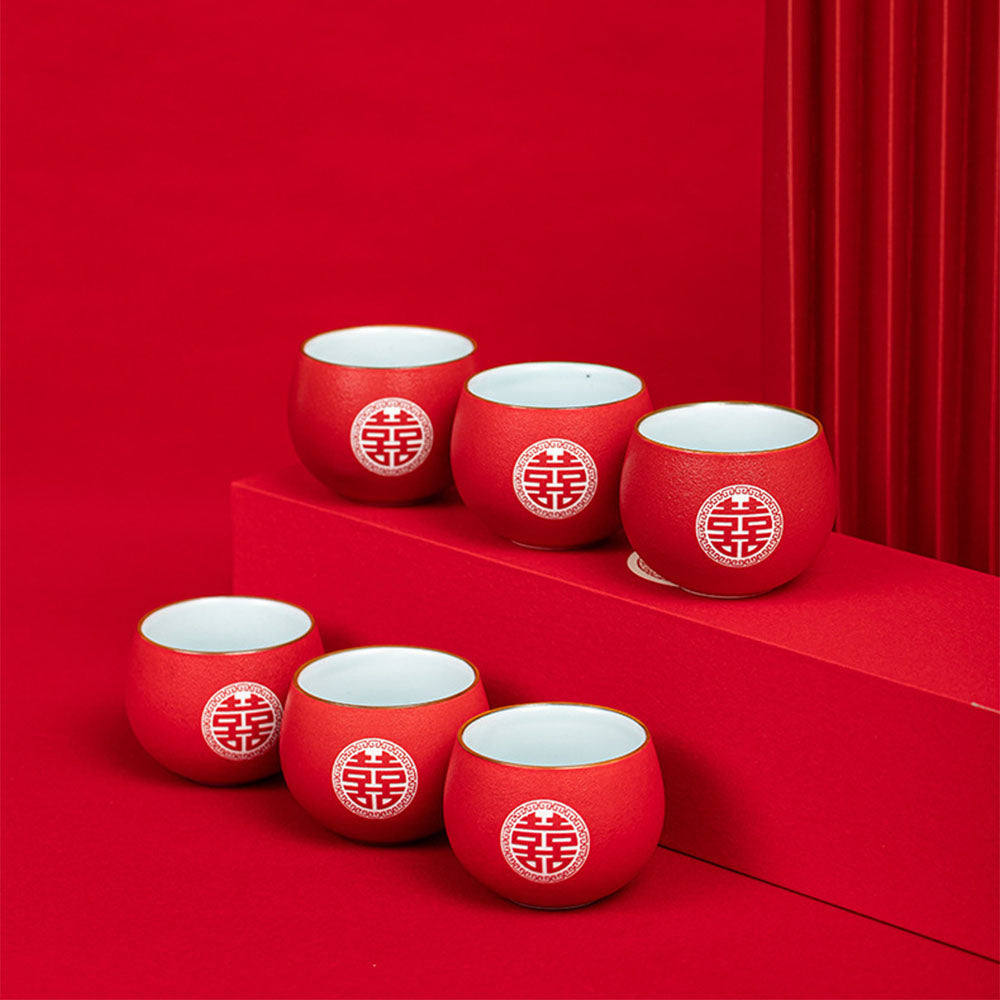 Vendor:Double Happiness Six Tea Cups SetUmi Tea Sets
- Regular price
-
$65.98 USD - Regular price
-
- Sale price
-
$65.98 USD
Quick view
-
Double Happiness Teapot With Four Gaiwans
 Vendor:Double Happiness Teapot With Four GaiwansUmi Tea Sets
- Regular price
-
$125.98 USD - Regular price
-
- Sale price
-
$125.98 USD
Quick view
-
Gradient Red Ceramic Wedding Tea Set
 Vendor:Gradient Red Ceramic Wedding Tea SetUmi Tea Sets
- Regular price
-
$156.98 USD - Regular price
-
- Sale price
-
$156.98 USD
Quick view
-
Double Happiness Ceramic Wedding Tea Set
 Vendor:Double Happiness Ceramic Wedding Tea SetUmi Tea Sets
- Regular price
-
$124.98 USD - Regular price
-
- Sale price
-
$124.98 USD
Quick view
-
Striped Double Happiness Ceramic Wedding Tea Set
 Vendor:Striped Double Happiness Ceramic Wedding Tea SetUmi Tea Sets
- Regular price
-
$128.98 USD - Regular price
-
- Sale price
-
$128.98 USD
Quick view
-
Mountain and Wave Ceramic Wedding Tea Set
 Vendor:Mountain and Wave Ceramic Wedding Tea SetUmi Tea Sets
- Regular price
-
$159.98 USD - Regular price
-
- Sale price
-
$159.98 USD
Quick view
-
Golden Double Happiness Ceramic Wedding Tea Set
 Vendor:Golden Double Happiness Ceramic Wedding Tea SetUmi Tea Sets
- Regular price
-
$149.98 USD - Regular price
-
- Sale price
-
$149.98 USD
Quick view
-
Peony Double Happiness Ceramic Wedding Tea Set
 Vendor:Peony Double Happiness Ceramic Wedding Tea SetUmi Tea Sets
- Regular price
-
$139.98 USD - Regular price
-
- Sale price
-
$139.98 USD
Quick view
-
Red Double Happiness Ceramic Wedding Tea Set
 Vendor:Red Double Happiness Ceramic Wedding Tea SetUmi Tea Sets
- Regular price
-
$98.98 USD - Regular price
-
- Sale price
-
$98.98 USD
Quick view


What is a Chinese Wedding Tea Set?
China is a country of etiquette, and there is a custom of giving gifts in social relations. For example, on holidays, when friends and relatives get married, they usually bless them with well-prepared gifts. Giving tea set is also the most elegant way. Therefore, Chinese wedding tea sets are gradually becoming popular as wedding gifts. With the in-depth influence of Chinese tea culture, Chinese wedding tea sets have become a good choice of more and more people.
In China, there are more and more people choose to hold an tea ceremony to show the bride and groom's family respect. In China-style wedding, it is always an unique part to serve tea, at which the bride and groom will do oriental prostrations and serve the tea to their parents.
Chinese wedding tea set is necessary for traditional Chinese wedding tea ceremony - tea-serving and called changing ceremony. In this rite, newlyweds call their parents “Dad” and “Mom” and serve them tea, uniting the two families in marriage. It symbolizes filial piety, gratitide, family’s blessings and best wishes to newlyweds.
Traditional Chinese wedding tea sets come in an impressive range of forms, typically designed in a festive style. Many are made from bright red porcelain in the form of a San Cai Gaiwan Set consisting of a lid, bowl and saucer. Many tea sets also come with a matching teapot, a red serving tray. They are vibrant, cheerful pieces that aptly celebrate the festive occasion of a Chinese wedding.
The wedding tea set is connected to both the tea and the tea vessels. The tea leaves used for the wedding tea are strong, enduring and evergreen, symbolizing the lasting love of the two newlyweds. The San Cai Gaiwan has deep symbolic meaning to it. The lid symbolizes heaven, the bowl symbolizes the people and the saucer symbolizes earth. Therefore, the gaiwan represents the harmony of heaven, earth and humanity and blesses the couple with a peaceful, happy, healthy and long-lasting family life.
A basic Chinese wedding tea set should follow three important principles: it should be festive, paired, and complete. A standard set usually includes one teapot, four cups, two saucers. This arrangement is suitable for serving tea to both parents, with two cups prepared for each side of the family. As to the colors for a wedding tea set, bright red, wine red and red with gold accent are the most common ones since they are most festive and symbolic of tradition. Pure white, black, gray or any cold and dark colors are not suggested for they can weaken the joyous atmosphere of wedding, going against the traditional Chinese meaning of fortune.
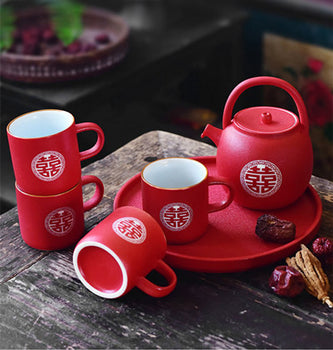
How to Use a Chinese Wedding Tea Set During the Wedding Ceremony
1. Preparation Before the Wedding Ceremony
Inspect the wedding tea set prior to the tea ceremony for cracks, stains, or missing pieces. Ensure all elements of the tea set are thoroughly cleaned including the gaiwan, cups, tray, etc. If kneeling cushions are used, they should also be placed properly according to the couple's position, usually following the traditional rule of "groom on the left, bride on the right."
The tea should also be prepared in advance. It is best to choose tea with a mild taste and a positive meaning, such as Longjing, Biluochun, or Tieguanyin. Also you can use Eight Treasure Tea (八宝茶). The tea should be poured to about seven-tenths full. In Chinese etiquette, filling a cup too full can be considered impolite. Pouring the tea to seven-tenths full shows respect and also helps prevent the tea from spilling during the ceremony. Some families also place two red dates and two lotus seeds in each cup, symbolizing "having children early" and "good things in pairs," which are traditional blessings for the newlyweds.
It is also helpful to arrange support from the bridesmaids and groomsmen. They can help carry the tray, pass the tea cups, and collect the cups after the parents drink the tea. This prevents the couple from becoming flustered while holding the tea set and helps the ceremony go smoothly. The bridesmaids and groomsmen should also be told the correct order and details of the tea-serving process in advance to avoid mistakes.
2. Tea-Serving Process
The tea ceremony usually follows the order of serving tea to the bride's parents first, then the groom's parents, as a gesture of respect to the bride's family.
Traditionally, the newlyweds would also serve tea to the bride's parents. When doing so, they would be sitting in front of their parents with their hands together in a prayer-like position, and the bridesmaid/groomsman would be bringing out a red tray with two tea cups. The couple would pick up the tea cups with both hands. They usually serve the mother first, followed by the dad. The newlyweds would say "Mom" or "Dad" before server them with tea. After the parents drink the tea, they give the couple red envelopes, also known as "called changing red envelopes," which represent acceptance, recognition, and blessings. The newlyweds receive the red envelopes with both hands and say thank you to their parents.
The process is then repeated for the groom's parents. The newlyweds stands in front of the groom's parents, serves tea with both hands, calls them "Mom" and "Dad," and receives the red envelopes after the parents drink the tea. The newlyweds should again show gratitude and respect throughout the process.
3. Important Details During Use Wedding Tea Set
When the newlyweds serving tea to their parents, the newlyweds should always hold the tea cup with both hands. The rim of the cup should be slightly lower than the parents' hands to show respect from the younger generation to the elders. The cup should not be held with one hand, and it should not be raised too high.
The temperature of tea should be tried in advance. It should not be too hot, as this could burn the parents when they drink it or burn the couple while they are holding the cups. Warm tea is more suitable for the wedding ceremony.
After the tea ceremony ends, the bridesmaids and groomsmen should help collect and organize the tea set in time. The tea set should be stored carefully to avoid damage. Many couples keep their wedding tea set as a meaningful wedding keepsake, and it can also be used later in daily family life, continuing the beautiful meaning of the ceremony.
How to Select a Wedding Tea Set
When you select a wedding tea set, the most important thing is to select one that matches the joyful and auspicious meaning of the wedding. The design should symbolize love, harmony, completeness, respect, and good fortune. Patterns with negative meanings or dark, gloomy styles should be avoided. In general, the designs can be divided into recommended patterns and taboo patterns.
1. Recommended Patterns
Dragon and phoenix patterns are one of the most traditional designs for Chinese wedding tea sets. The dragon stands for the groom, while the phoenix for the bride. When shown together, they stand for the union of a couple and an everlasting marriage. They are often adorned with gold, which makes the tea set look more cheerful, stylish and stunning.
Double Happiness patterns are also very popular. A single Chinese character for happiness or the traditional Double Happiness symbol "囍" directly matches the wedding theme. This design is simple, clear, and meaningful, symbolizing joy, good fortune, and a complete marriage. It is suitable for almost all Chinese wedding styles and is easy to recognize.
Another positive option could be floral patterns, particularly when carrying connotations of positive ideas. Peony represent wealth, good luck and happiness of family; Lotus flowers represent purity, loyalty and long-lasting love; Plum blossom represents solid and loyal love that will last through hardships. Floral patterns are usually symmetrical, which is consistent with the connotation of pair and intimacy in marriage.
Some auspicious traditional patterns can be used for the wedding tea set. For instance, clouds, scrolling vine patterns, mandarin ducks, magpies on the plum branches and so on. Clouds can stand for luck, auspicious and smooth blessings. The scrolling vine patterns imply continuous growing and endless love. The mandarin ducks and magpies are for harmony of marriage, love forever and growing old together. All these patterns are full of traditional feelings but with good wishes for marriage.

2. Patterns to Avoid
Another patterns to avoid is those that imply separation or brokenness, such as a single bird, a single flower, broken porcelain, or broken branches. These images imply loneliness, separation, or incompletion which are not compatible with the wedding message of unity and a life-long partnership.
Dark, strange, or gloomy patterns are also unsuitable. Designs in heavy black tones, skulls, ghosts, or frightening images can make the tea set feel depressing and may damage the joyful mood of the wedding. They also do not fit traditional Chinese ideas of celebration and good fortune.
Unrelated or disorder pattern should also be avoided. For instance, illustrations of cartoon characters, contemporary abstract pictures with no lucky connotations or images with words of unpleasant meaning are unlikely to create a proper sense of ceremony. Besides, they are unable to convey the beautiful aspirations and blessings of marriage.

3. Additional Tips for Choosing a Wedding Tea Set
The color of the tea set is also another important point to be considered once you decide on the pattern. Red with gold painting or red with gold-penny stamp is generally chicer and more suited for a wedding. For a simple and modern Chinese wedding, a clean Double Happiness or cloud pattern is fine; for a traditional celebration, oriental dragon and phoenix, peony, mandarin duck or other traditional auspicious pattern is more suitable.
Furthermore, the pattern should also be clear and well crafted. Do not choose a wedding tea set with blurry patterns, rough workmanship and the prints could possibly fade easily. A good wedding tea set with neat workmanship could be beautiful during the wedding as well as a valuable memento after the wedding.