
Collection: Yixing Teapots
57 products
-
Yixing Dragon Bone Gold Sand Landscape Teapot
 Vendor:Yixing Dragon Bone Gold Sand Landscape TeapotUmi Tea Sets
- Regular price
-
$78.98 USD - Regular price
-
- Sale price
-
$78.98 USD
Quick view
-
Yixing Purple Clay Peony Xi Shi Teapot
 Vendor:Yixing Purple Clay Peony Xi Shi TeapotUmi Tea Sets
- Regular price
-
$86.98 USD - Regular price
-
- Sale price
-
$86.98 USD
Quick view
-
Yixing Green Clay Lotus Shi Piao Teapot
 Vendor:Yixing Green Clay Lotus Shi Piao TeapotUmi Tea Sets
- Regular price
-
$79.98 USD - Regular price
-
- Sale price
-
$79.98 USD
Quick view
-
Yixing Dragon Bone Gold Sand Dragon Teapot
 Vendor:Yixing Dragon Bone Gold Sand Dragon TeapotUmi Tea Sets
- Regular price
-
$89.98 USD - Regular price
-
- Sale price
-
$89.98 USD
Quick view
-
Yixing Black Clay Dragon Teapot
 Vendor:Yixing Black Clay Dragon TeapotMaker: 谢道礼
- Regular price
-
From
$147.98 USD - Regular price
-
$177.58 USD - Sale price
-
From
$147.98 USD
Quick view
-
Yixing Purple Clay Dragon Shipiao Teapot
 Vendor:Yixing Purple Clay Dragon Shipiao TeapotMaker: 韩传杰
- Regular price
-
$90.98 USD - Regular price
-
$109.18 USD - Sale price
-
$90.98 USD
Quick view
-
Old Purple Clay Hexagonal Teapot
 Vendor:Old Purple Clay Hexagonal TeapotMaker: 邵云琴
- Regular price
-
$93.98 USD - Regular price
-
- Sale price
-
$93.98 USD
Quick view
-
Yixing Stone Yellow Clay Landscape Octagon Teapot
 Vendor:Yixing Stone Yellow Clay Landscape Octagon TeapotUmi Tea Sets
- Regular price
-
$78.98 USD - Regular price
-
- Sale price
-
$78.98 USD
Quick view
-
Yixing Green Clay Lotus And Frog Teapot
 Vendor:Yixing Green Clay Lotus And Frog TeapotUmi Tea Sets
- Regular price
-
$65.98 USD - Regular price
-
- Sale price
-
$65.98 USD
Quick view
-
Yixing Purple Clay Plum Tree Stump Teapot
 Vendor:Yixing Purple Clay Plum Tree Stump TeapotMaker: 蒋静明
- Regular price
-
$115.98 USD - Regular price
-
$133.38 USD - Sale price
-
$115.98 USD
Quick view
-
Yixing Red Clay Pomegranate Teapot
 Vendor:Yixing Red Clay Pomegranate TeapotUmi Tea Sets
- Regular price
-
$108.98 USD - Regular price
-
- Sale price
-
$108.98 USD
Quick view
-
Yixing Purple Clay Peony Shi Piao Teapot
 Vendor:Yixing Purple Clay Peony Shi Piao TeapotUmi Tea Sets
- Regular price
-
$55.98 USD - Regular price
-
- Sale price
-
$55.98 USD
Quick view


What is a Yixing Teapot?
The purple clay teapot originally is Chinese first hand-made clay handicrafts, and its raw materials' origin is in Yixing of Jiangsu Province. So it is also called Yixing purple clay teapot. The purple clay teapot is of function and ornamental.
Yixing Clay Teapots Has a Variety of Models
There are a variety of teapot models, and there is always a saying "not one kind square, and all kinds of round". The purple clay teapot can be traditionally embellished into geometric shapes, natural shape and tendon profile sharp. Geometric shape teapots, mainly are square, spherical, or cylindrical. Generally the circular one is relatively soft, with beautiful lines, curves, while the square device is very powerful.
The natural shape generally takes plants and animals as the prototype. Some of these works are directly made with the shape of a variety of items, such as pumpkin pot, persimmon flat pot and so on, and some pots are carved on the body, such as ivy pot, pot of primrose.
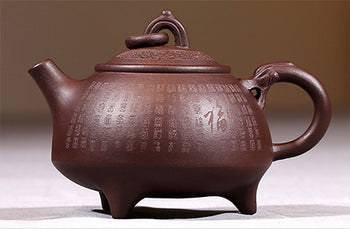
Tendon profile shape take the flowers and fruits in the nature as pattern, create vivid and smooth muscle pot. Such pots are not only a beautiful pot style, but also with the rigorous producing process, especially in the flap part, and the seam is very tight. The lid should be turned, and the pot body pattern is both of density and decency.
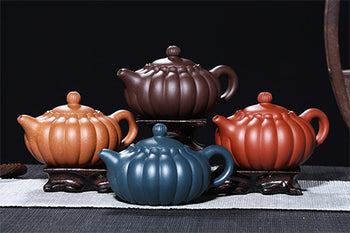
The purple clay teapot is ventilating, and it is not easy to change taste if it is used to make tea, even if the tea is placed for two days, it is still fragrant. This kind of pot just needs simply washing without use for a long time, without any odor. Tea can emit fragrance with this purple teapot.
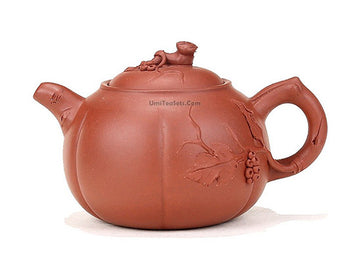
What are the Features of Yixing Teapots?
1. Unique adsorption
Teapot's good ventilation also created another unique quality, which is the strong adsorption. It will continue to absorb tea aroma when teapot is used, and after a long time, it will create a aroma. Therefore, the top purple clay teapot can make the same type to avoid flavor mixing, which affects its taste.
2. The more nourished, the more spiritual
For many appliances, the more you use, the older they are, but the more you use, the better the purple clay teapot is. The pot body will be more and more shiny, smooth, beautiful and mild after frequent cleaning.
3. Resist hot and cold temperature
Teapot is sandy and it transfers heat slow, so it has a good stability of hot and cold, even if burned directly on the stove, it will not be split.
How Many Types of Clay are Used for Yixing Teapots? What are the Differences, and Which Teas are They Best for?
The raw mineral clays used for a Yixing teapot are generally classified by mining layer, mineral composition, and firing color. The mainstream categories are Zi Ni, Hong Ni, Lü Ni, and Duan Ni. In the market, there are around 15 commonly used sub-types suitable for making teapots. Different clays vary in shrinkage rate, firing temperature, particle size, and breathability, which directly affect the teas they suit and the difficulty of maintenance. Below is a detailed breakdown of the commonly used clays, their characteristics, and their recommended uses.
I. Zi Ni Series (紫泥)
(Market mainstream, most widely applicable, first choice for beginners)
Zi Ni comes from the middle layer of the Yixing clay ore strata on Huanglong Mountain. It has a high iron content, relatively large particles, and a complete, breathable dual-porosity structure. It is the most commonly used clay for making a Yixing Teapot. When fired it turns to a beautiful purple-brown or reddish-brown. The clay is very stable and has a high finished-product ratio.

1. Ordinary Zi Ni (普通紫泥)
Core Characteristics: It is produced in the middle layer of the mineral layer, with a uniform purple-brown tone, moderate particle size, loose body structure, smooth air convection, and rapid changes after soaking and conditioning. The firing temperature is 1120 to 1150°C, the shrinkage rate is 12% to 15%. It is easy to process and stable in mass production.
Suitable Teas: All Pu-erh teas, lightly roasted oolong, Longjing, flower tea, Biluochun, black tea, and green tea.
User Experience: Ordinary Zi Ni is durable and forgiving. It is not picky about tea or maintenance conditions. Even with casual daily use, it can naturally develop a patina. After 3 to 6 months of continuous use, the surface gloss of the teapot will become noticeably better. It is ideal for beginners and for everyday use.
2. Di Cao Qing (底槽青)
Core Characteristics: The raw material from the bottom layer of the purple clay ore contains bluish-green, chicken-eye and cat-eye-shaped mineral spots. Its texture is pure and delicate, making it a high-quality variety of purple clay. Firing temperature is 1130 to 1160℃, with a shrinkage rate of 10% to 13%. After firing, it turns a deep reddish-liver color with a stable and dignified appearance.
Suitable Teas: All Pu-erh teas, lightly roasted oolong, Longjing, flower tea, Biluochun, black tea, and green tea.
User Experience: After being steeped and aged, the Di Cao Qing will turn a dark, antique liver color with a warm and full-bodied texture. When brewing ripe Pu-erh tea, it can effectively reduce the musty taste and make the tea soup smoother. It is recommended to brew only one type of tea to avoid cross-contamination of flavors, which can cause the patina to darken.
3. Qing Shui Ni (清水泥)
Core Characteristics: Pure raw Zini clay processed directly without any additives. It was also commonly used in ancient pottery making. Its moisture level is easy to control, and it has high shaping stability. Aged clay must be reworked before use, otherwise black edges or mixed-color patches may appear. Firing temperature is 1120-1150°C, with a shrinkage rate of 13%-16%. Its clay color is simple and antique, and after use it develops a reddish, rustic glow.
Suitable Teas: All Pu-erh teas, lightly roasted oolong, Tieguanyin, flower tea, black tea, green tea, Longjing, and Biluochun.
User Experience: Qing Shui Ni feels warm and smooth in the hand, is easy to clean, and does not easily retain stubborn tea stains. It is especially suitable for office use. It develops a patina faster than ordinary Zini, and the first visible results can usually be seen after 1 to 2 months.
4. No. 2 Zi Ni (二号紫泥)
Core Characteristics: Contains a relatively high proportion of hematite, giving it a purplish-red or reddish-brown color. The clay is fine, even, highly plastic, and the body is compact. Firing temperature is 1140-1170°C, with a shrinkage rate of 11%-14%. Its gloss is better than that of ordinary Zini.
Suitable Teas: Oolong tea, Pu-erh tea, black tea, and green tea.
User Experience: No. 2 Zini has a bright color and is better at bringing out tea aroma. It suits highly aromatic teas particularly well. After use, it develops an obvious shine and offers both visual appeal and practicality.
II. Hong Ni Series (红泥)
(Bright in color, high in shrinkage, and often used for small-capacity teapots)
Hong Ni has a relatively high iron oxide content. In its raw state, it is as hard as stone. It is sensitive to firing temperature and has a higher shrinkage rate than Zi Ni. After firing, it usually appears red or orange-red. Its color changes strongly when exposed to hot water, becoming brighter with use.

1. Ordinary Hong Ni (普通红泥)
Core Characteristics: The raw ore appears pale grass-green. It is fired at a relatively low temperature and is suitable for making small teapots. Firing temperature is 1080-1110°C, with a shrinkage rate of 18%-22%. If the temperature is too low, the color becomes dull yellow-orange; if too high, the piece may deform or collapse.
Suitable Teas: Oolong tea, Tieguanyin, rock tea, and Pu-erh tea.
User Experience: Small Hong Ni teapots feel comfortable in the hand. When brewing Tieguanyin, they release aroma more fully. The color-changing effect is obvious, and after 1 to 2 months the teapot will show a noticeably deeper tone. During use, sudden temperature changes should be avoided to reduce the risk of deformation.
2. Zhu Ni (朱泥)
Core Characteristics: A premium type within Hong Ni. It belongs to clayey mudstone, has a soft cinnabar-red tone, a dense and smooth body, and an extremely high shrinkage rate. It cannot be used to make large teapots and is limited to small teapots. Firing temperature is 1050-1080°C, with a shrinkage rate of up to 30% and a finished-product rate of about 70%. After firing, the teapot surface shows fine wrinkled lines.
Suitable Teas: Tieguanyin, Taiwan high mountain tea, raw Pu-erh, lightly roasted oolong, and Longjing.
User Experience: A Zhu Ni teapot is made for highly aromatic teas. Its aroma-gathering effect is much stronger than that of other clays. When brewing high mountain tea, it can hold the aroma inside the teapot very well. Its drawback is fragility. Cold water must never be poured directly over a hot teapot, or it may crack easily. The initial seasoning process must also be done more carefully.
3. Da Hong Pao (大红袍)
Core Characteristics: A top-grade material within Zhu Ni. The raw ore is yellow and comes from Zhaozhuang Mountain in Dingshan. Its shrinkage rate is nearly three times that of Zi Ni. The clay is dense, and the teapot feels heavy in the hand. Firing temperature is 1060-1090°C, with a shrinkage rate of 28%-32%. After firing, it appears bright red and richly textured.
Suitable Teas: Lightly roasted oolong, medium- to heavily roasted Tieguanyin, and all Pu-erh teas.
User Experience: After long-term use, Da Hong Pao becomes bright red like cinnabar and develops an excellent patina. When brewing heavily roasted teas, it can greatly improve the thickness and richness of the tea liquor. The teapot must always be preheated before use so that a cold teapot does not affect the taste of the tea.
4. Hong Pi Long (红皮龙)
Core Characteristics: Formerly called wild mountain red clay. It is rare and mined below the yellow stone layer. The clay is reddish-brown in raw form and turns true red after firing, while preserving a complete dual-porosity structure. Firing temperature is around 1100°C, and shrinkage rate is 15%. Its breathability is better than that of ordinary Hongni.
Suitable Teas: Pu-erh teas, Tieguanyin, semi-fermented tea, dark tea, lightly roasted oolong, green tea, Longjing, and black tea.
User Experience: Hong Pi Long is the most durable variety within the Hongni family. Its breathability is balanced, and it is not picky about the degree of tea fermentation. It does not make green tea taste stuffy, and it can reduce astringency when brewing dark tea. It offers both appearance and practicality.
5. Jiang Po Ni (降坡泥)
Core Characteristics: Jiang Po Ni is a common symbiotic clay within the Hong Ni family. It comes from the Jiangpo excavation area located between Huanglong Mountain and Qinglong Mountain, and is formed as a natural combination of Qing Shui Ni and Ben Shan Lüni. Its raw color is orange-red with a yellowish tone, and the texture is fine and delicate, containing particles of Hong Ni, Zi Ni, and Duan Ni. It is typically fired at 1120–1150°C, with a shrinkage rate of 18%–22%. After firing, the surface develops a rich, moist sheen. Its dual-porosity structure remains open and breathable, giving it a strong ability to absorb tea oils.
Suitable Teas: Rock tea, oolong tea, all types of Pu-erh tea, black tea, and dark tea. It is especially well suited to medium - to heavily roasted Tieguanyin and aged ripe Pu-erh.
User Experience: Jiang Po Ni is one of the more versatile clays in the Hong Ni family. After long-term use, it develops layered color variations and a deep, aged character, with a texture that comes close to the old clays seen in the Ming and Qing periods. Compared with ordinary Hongni, it is more resistant to sudden temperature changes and is moderate in maintenance difficulty, so even beginners can use it with confidence. When used for aged ripe Pu-erh, it can noticeably improve the lingering sweetness of the tea liquor.
III. Lü Ni Series (绿泥)
(Rare raw material, fresh in color, and excellent in breathability)
Lüni is mainly produced in Huanglong Mountain, Dingshu, Yixing. The raw ore is pale green. Its fired color changes with temperature: low-temperature firing gives a beige tone, suitable temperatures give a yellowish-brown tone, and high-temperature firing produces a bronze-like tone. The ore reserves are limited, making it a relatively rare clay.

1. Ben Shan Lü Ni (本山绿泥)
Core Characteristics: A high-quality Lü Ni material belonging to sheet-like mixed clay. The raw ore surface is as smooth and delicate as a shell and contains almost no sandy particles. Firing temperature is 1100-1130°C, with a shrinkage rate of 12%-15%. After firing, it appears yellow-green, with clear particles and rich texture.
Suitable Teas: Lightly roasted oolong, medium- to heavily roasted Tieguanyin, all Pu-erh teas, black tea, and green tea.
User Experience: Ben Shan Lü Ni has a fresh appearance and is especially suitable for brewing green tea and white tea, making the liquor taste cleaner and fresher. It must be kept away from grease during maintenance. Once oil sticks to the surface, it is difficult to remove and will directly affect both color and patina.
2. Mo Lü Ni (墨绿泥)
Core Characteristics: The raw ore is dark green, sticky, fine, and dense. It requires precise firing temperatures and is prone to deformation during firing. Firing temperature is 1110-1140°C, with a shrinkage rate of 14%-17%. Low-temperature firing produces beige or light yellow, while high-temperature firing gives a greenish tone.
Suitable Teas: Oolong tea, Pu-erh tea, green tea, and black tea.
User Experience: Mo Lü Ni has a delicate texture and develops a soft glow after use. It is suitable for lightly fermented teas. High-quality Mo Lü Ni teapots are produced in small quantities, so buyers should make sure the material is genuine raw ore.
3. Sesame Lü Ni (芝麻绿泥)
Core Characteristics: The raw ore is bluish-green. After firing, the body is covered with many black sandy speckles, and it is divided into white-sesame clay and red-sesame clay. Its texture is bold and rustic. Firing temperature is 1100-1130°C, with a shrinkage rate of 13%-16%. It has a strong ability to absorb tea oils.
Suitable Teas: Dark tea, ripe Pu-erh, and oolong tea.
User Experience: Sesame Lü Ni has a strong granular feel. When brewing ripe Pu-erh, it can enhance the thickness of the liquor. Its appearance is distinctive and suits people who prefer a rougher, more rustic style.
IV. Duan Ni Series (段泥)
(A symbiotic ore with rich colors and excellent patina development)
Duanni, formerly called Tuan Ni, is a symbiotic ore formed by the natural combination of Zi Ni, Lü Ni, and Hong Ni. It has relatively large particles, a loose structure, and a very obvious dual-porosity structure. In the past, low-temperature firing often caused black spotting, but this problem has now been completely solved through high-temperature kiln firing. After firing, it usually appears satin yellow or bluish gray.

1. Old Duan Ni (老段泥)
Core Characteristics: Made from aged Duan Ni material with high ore purity, calm color, rich particles, and excellent breathability. Firing temperature is 1130-1160°C, with a shrinkage rate of 12%-15%. It does not develop black spotting, and its patina changes significantly over time.
Suitable Teas: Pu-erh teas, Tieguanyin, semi-fermented tea, dark tea, lightly roasted oolong, green tea, Longjing, and black tea.
User Experience: Old Duan Ni is the most practical variety within the Duan Ni family. It is easy to maintain, not picky about tea, and suitable for both home and office use. With long-term use, it develops a warm and mellow patina. It is the best entry-level choice for beginners who want a Duan Ni teapot.
2. Golden Duan (黄金段)
Core Characteristics: A symbiotic ore that fires into a golden yellow to bright yellow color. Its particles are clearly visible, and it has strong tea-enhancing performance, effectively bringing out aroma. Firing temperature is 1120-1150°C, with a shrinkage rate of 11%-14%. It has a bright appearance and strong visual appeal.
Suitable Teas: Raw Pu-erh, Fenghuang Dancong, oolong tea, and green tea.
User Experience: Golden Duan has a vivid color that sets off the color of the tea liquor beautifully, making it especially suitable for fragrant teas with a fresh style. During maintenance, it should be cleaned regularly to prevent tea scale from building up and darkening the color.
3. Sesame Duan (芝麻段)
Core Characteristics: Duan Ni mixed with black sandy particles. After high-temperature firing, it becomes dark brown, with a rough granular texture and strong absorptive ability. Firing temperature is 1130-1160°C, with a shrinkage rate of 13%-16%. It can effectively absorb tea impurities.
Suitable Teas: Dark tea, ripe Pu-erh, and heavily fermented tea.
User Experience: Sesame Duan performs best with heavily fermented teas. It can soften miscellaneous flavors and make the liquor smoother. Its look is niche and distinctive, suitable for users who want something more individual.
4. Qicai Duan and Xiehuang Duan (七彩段、蟹黄段)
Core Characteristics: These are artificially blended Duanni clays. Xiehuang Duan appears orange-yellow, while Qicai Duan contains multicolored particles and has strong plasticity. Firing temperature is 1120-1150°C, with a shrinkage rate of 12%-15%. Their performance is basically the same as natural Duanni.
Suitable Teas: Oolong tea, black tea, green tea, and Pu-erh tea.
User Experience: The main advantage of these Duan Ni types is visual appeal. Their practicality is no different from Old Duan Ni, making them suitable for users who prefer beautiful tea ware. Their maintenance method is exactly the same as that of natural Duanni.
The Following Points Should be Noted When Using a Yixing Teapot.
As a kind of tea set for appreciation and practical uses, purple clay teapot is the favorite thing for literature lovers in different historical stages in ancient China. Speaking of purple clay teapots, it originates from the Song dynasty and developed in the Ming dynasty, and peaked at the time ruled by Kang Xi and Qian Long in the Qing dynasty in terms of techniques and appreciation and collection. Also, the main characteristics of purple clay teapots are the common wealth of the descendants.
Due to the uniqueness of purple clay teapots, it looks even more dashing when applied to the daily uses. Yixing teapots are made by coarse sand which contains less grit. Using this kind of teapot will not cover up the scent of the tea. Truly, this kind of teapot can balance well between the color, aroma and the taste of tea. Technicians on porcelain and food have jointly conducted experiments in three months' time on the practical value of purple clay teapots. They have used TC-PIIG automatic color identification technique and chromatism detection technique. This experiment ranges from Yixing purple-clay teapots, Yixing cinnabar teapots, and white porcelain teapots and glass teapots. They used these containers to brew green tea, brown tea and oolong tea and analyze the color, aroma, taste, residue of the tea, tea polyphenols, caffeine, reduced sugar, theanine, tea cream, etc. The result is, the former two kinds of purple clay teapots in better than other porcelain teapots and glass teapot. Having identified the quantity of Vitamin C and microbes by quantitative analysis, purple-clay teapots are the perfect one of all, which is hard for tea to go bad.
First, the pot may be full of strange odors, so you have to throw away the residue out of it and pour hot water to wash the inner side of the pot. Then, pour out the hot water and dip the pot in the cool water. As a result of it, this odor is gone.
Second, the texture of the pot in hard to conduct heat and perfect for maintaining the temperature. When you are holding it with hot water inside, you will not feel burning in hand, also, it can warm you hand and that is good for your body.
Third, there are two blowholes in the purple-clay teapot, so it can adjust its temperature when meeting with cold or hot water. In cold weather, hot water will not split the whole purple-clay teapot. You do not need to worry any more when stewing or boiling things within it.
Fourth, it can be used for quite a long time. Especially, when you touch it very often, the teapot will become even more shining and brighter than ever before.
Fifth, the inner side of the teapot can absorb the fluid of tea. Although you never clean the stain of tea on it, it never smells odd and even release the aroma of tea. The stain of tea on the inner side of the teapot has been proved to have the ability to kill bacteria by biological experiments, because it contains flavomycin.
Sixth, there are tall and short purple-clay teapots. According to the rules of brewing tea, tall pots are suitable for making brown tea, because brown tea is fermented. So brown tea cannot be contained in stuffy containers, also, it is more tasteful in tall pots. While short teapots is for green tea, because green tea is not fermented and not suitable for stuffy pot, so as to maintain the green color, wonderful taste of green tea.
Seventh, when using, maintaining the pot, the surface cannot be painted with oil. In addition, you cannot suck the spout of the teapot so as to maintain the natural brightness of its surface and maintain the original taste of the tea.
How to Nourishing Your Yixing Clay Teapot?
The core logic of nurturing a Yixing teapot is to allow the teapot's dual pores to absorb tea oils evenly and gradually form a natural, translucent patina, while protecting the clay structure from damage. There are no complicated operations involved. As long as the steps are followed properly, the teapot can steadily develop a high-quality patina. The following methods are practical and based on long-term use, with no vague steps, so they can be followed directly.
I. Initial Seasoning for a New Yixing Teapot (A necessary step to remove impurities and earthy odor)
A new Yixing teapot may still carry kiln dust, mineral powder, and an earthy smell inside. If used directly, these can affect the taste of the tea. That is why it must be seasoned before use. The purpose of seasoning is to open the pores, remove impurities, and help the teapot absorb and stabilize tea aroma.
1. Room-Temperature Rinsing
Rinse the inside and outside of the teapot under running room-temperature water. Use a soft toothbrush to gently clean the rim, base, lid gap, and other corners where residue may remain. The rinsing process should last 1 to 2 minutes. No detergent should be used at any stage.
2. Warm-Water to Soaking to Clay
Prepare warm water at 40-50°C and fully submerge the teapot for 30 minutes. This softens any remaining mineral residue inside the body and allows the pores to begin opening, preparing the teapot for later absorption of tea oils.
3. Boiling-Water Expansion
Remove the teapot from the water and slowly pour 100°C boiling water over the inside and outside of the teapot. Repeat this 3 to 5 times. The heat fully opens the dual pores and thoroughly removes earthy or kiln-fired odors.
4. Tea-Liquor Aroma Setting
Choose the tea you plan to brew in this teapot long term. Brew a strong tea with boiling water, fill the teapot with the tea liquor, and let it soak for 2 hours. This allows the teapot to absorb the initial aroma of that tea and reduces the chance of flavor mixing later.
5. Natural Drying
Pour out the tea liquor, wipe away surface moisture with a soft cotton cloth, and place the teapot in a ventilated area away from direct sunlight. Let it dry naturally for 12 hours. After that, it is ready for normal use.
User Experience: During the entire seasoning process, dish soap and steel wool must never be used. These can block the pores and permanently reduce breathability. If the teapot is seasoned with the same tea it will later be used for, the patina color will become more even and will not develop blotchy patches.
II. Daily Usage Rules (The key stage for speeding up patina development)
1. One Tea for One Teapot
One Yixing teapot should be dedicated to one tea only. For example, a Pu-erh teapot should be used only for Pu-erh, and a Tieguanyin teapot should be used only for Tieguanyin. Mixing different teas in the same teapot is not recommended. According to experience, mixed use slows patina development by about 30%, darkens the surface, reduces gloss, and may also cause flavor contamination.
2. Always Preheat the Teapot
Before brewing, rinse the teapot with boiling water for about 10 seconds to preheat it. This helps release the aroma of the tea while also preventing a cold teapot from being shocked by boiling water. For high-shrinkage clays such as Zhu Ni and Da Hong Pao, this step must never be skipped.
3. Leave a Little Tea Behind
After finishing the tea, leave 1 to 2 sips of tea liquor at the bottom instead of pouring the teapot completely dry. Let it sit for 5 to 10 minutes so the liquor can naturally moisten the base, then pour it out and let the teapot dry. This helps the base develop patina faster and prevents uneven color between the upper and lower parts of the teapot.
4. Match the Water Temperature to the Tea
Use water at 85-90°C for green tea and white tea so that delicate leaves are not scalded. Use 100°C boiling water for Pu-erh, oolong, and dark tea in order to fully release their inner substances while also keeping the teapot's color stable.
III. Daily Cleaning Methods (Simple and effective, without damaging the clay)
1. Clean Immediately
After drinking tea, rinse the inside of the teapot with boiling water while it is still warm. Tea scale will come off naturally, and the teapot wall can be gently brushed with a soft brush. There is no need to scrub hard. Cleaning while warm is the key to preventing stubborn tea stains.
2. Never Use Cleaning Agents
Dish soap, hand soap, laundry detergent, and other chemical cleaners must never be used. Chemical substances can block the pores and leave a permanent odor that cannot be removed.
3. Removing Stubborn Tea Stains
If long-term buildup creates stubborn tea stains, mix edible alkali with warm water to make a 5% solution, soak the teapot for 10 minutes, and then clean it with a soft brush. This method is safe and will not damage the teapot. Steel wool and hard brushes must not be used, as they will scratch the surface permanently.
4. Standard Drying
After cleaning, wipe off the moisture with a soft cotton cloth and let the teapot dry in a ventilated place. Do not store it in a sealed container or drawer, otherwise humidity may cause mold or unwanted odor.
IV. Long-Term Care Tips (For faster patina development and better texture)
1. Wipe and Polish Frequently
After using the teapot each day, gently wipe the surface with a clean soft cotton cloth. The mild heat generated by friction helps tea oils enter the pores more quickly. With one month of consistent care, the teapot will show a visible increase in gloss and a more even patina.
2. Avoid Environmental Damage
Do not place the teapot in direct sunlight, as ultraviolet light can fade the color and dry out the patina. Do not leave it in a greasy kitchen, since oil stains are difficult to remove and will darken the clay. Avoid contact with perfume, mothballs, and other strong-smelling items, because a Yixing teapot can absorb odors and permanently affect the taste of tea.
3. Let the Teapot Rest and Dry
After 3 to 5 consecutive days of use, allow the teapot to dry completely for 24 hours. This lets the pores breathe fully and release internal moisture, resulting in a clearer, brighter patina rather than a dull or blackened one.
4. Prevent Physical Damage
After firing, the body of a Yixing teapot is relatively brittle. Avoid bumps and drops. Once cracks appear, they cannot truly be repaired, and they may trap dirt and bacteria, affecting normal use.
V. Common Mistakes to Avoid
1. Mistake: Soaking the Teapot in Tea for Too Long
Some people believe the longer the teapot is soaked in tea, the faster it will develop a patina.
Correction: If soaked for more than 4 hours, the teapot body becomes saturated with water and can no longer continue absorbing tea oils. It may also breed bacteria and develop a musty smell, which is counterproductive.
2. Mistake: Using Rough Cloth or Hard Brushes
Some people wipe the teapot with coarse fabric or stiff brushes.
Correction: This damages the patina that has already formed and leaves permanent scratches. Only soft cotton cloths and soft-bristle toothbrushes should be used.
3. Mistake: Using the Same Care Method for All Clays
Some people assume every clay type can be maintained in the same way.
Correction: Zhu Ni and Da Hong Pao must avoid sudden temperature changes; Lü Ni must avoid grease; Duan Ni must avoid long exposure to strong sunlight. Only by adjusting maintenance according to the clay type can the best results be achieved.
4. Mistake: Deep Cleaning Too Often
Some people do a full deep cleaning after every use.
Correction: Daily rinsing with boiling water is enough. Over-cleaning removes tea oils from the teapot body and slows down patina development.
User Experience: There is no shortcut to nurturing a Yixing teapot. There is no need to chase speed. As long as you use it correctly, clean it properly, and let it dry well, an even and mellow patina can form in 3 to 6 months. Patina is the natural result of regular use. Normal tea brewing and normal care are enough. The more the teapot is used, the smoother it feels, and the better the tea tastes. That is the unique value of a Yixing teapot.
Value of Art Collection of Yixing Teapots
Scarcity of Raw Material: The Non-Renewability of Original Ore Clay Lays the Foundation for Collectibility
The collectible value of Yixing teapots first comes from the scarcity of their core raw material - original Yixing zisha clay from Huanglong Mountain in Yixing. As mentioned earlier, authentic zisha teapots rely on the unique zisha ore found in Huanglong Mountain, and since 2005, this mining area has been subject to a protective closure policy that prohibits destructive extraction. Most of the high-quality original ore clay currently circulating on the market consists of stock reserved before the mine closure, and it is usually used for production only after long-term aging. Its non-renewable nature is therefore especially prominent.
Different categories of original ore clay vary greatly in collectible value. Among them, rare clays such as Da Hong Pao, Jiang Po Ni, and Tian Qing Ni are highly prized because of their limited mineral sources and difficult extraction, giving them extremely high raw material value in themselves. Even more common clays such as purple clay and Zhu Ni have seen their available stock decrease year by year after long periods of consumption. In particular, old clay aged for more than ten years tends to have a gentler texture and better breathability. Teapots made from such clay not only offer a better user experience, but also have far greater collectible potential than pieces made from newer clay. In addition, the natural characteristics of original ore clay are impossible to replicate, so each piece of clay carries unique mineral textures. This adds a one-of-a-kind rarity to zisha teapots, distinguishing them from imitation teapots made of ordinary pottery clay, and fundamentally determining the baseline of their collectible value.
Artistry of Craftsmanship: The Irreplaceability of Handmade Work Gives Collecting Its Soul
The collectible value of Yixing teapots lies at its core in the artistic depth of handmade craftsmanship. Truly collectible Yixing teapots are all made entirely by experienced local Yixing artisans. From kneading and preparing the clay, shaping and refining the form, to carving decoration and high-temperature firing, every step depends on the artisan's experience and skill, with no mold assistance throughout the process. This takes a long time and results in a low success rate, making it fundamentally different from mass-produced slip-cast wares.
The level of the artisan's skill directly determines the collectible grade of a Yixing teapot. Teapots made by experienced artisans, senior craft masters, or inheritors of intangible cultural heritage are not only regular in form, smooth in line, and exquisite in detail, but also embody the maker's own aesthetic vision and technical mastery. Whether in the simplicity and elegance of plain wares or the vivid refinement of carved pieces, such works possess extremely high artistic and visual value. By contrast, works made by ordinary craftsmen, though sufficient for daily use, often lack distinctive artistic expression and therefore have limited collectible value. In addition, because of the special nature of handmade production, every Yixing teapot has subtle differences - the texture of the body, the curvature of the lines, and the details of the carving can never be completely duplicated. This “one-of-a-kind” quality is precisely the core charm of collecting and a key value point that machine-made products cannot replace.
At the same time, an authoritative certificate of qualification is also an important piece of evidence supporting the craft value of a teapot. Collectible Yixing teapots are usually accompanied by a dedicated certificate specifying the clay type, artisan information, and production technique. This not only proves their handmade nature and original ore identity, but also provides authoritative support for future collecting, inheritance, and appreciation in value. It helps buyers avoid common market traps such as fake handmade pieces and fake clay claims, further enhancing the reliability of the teapot's collectible value.
Cultural Depth: The Fusion of Intangible Heritage Craftsmanship and Tea Culture Elevates Collecting
The collectible value of Yixing teapots also comes from the profound cultural heritage they embody. The traditional craftsmanship of Yixing zisha pottery was included in the first batch of China's national intangible cultural heritage list as early as 2006, and in 2010 it was approved as a product under national geographical indication protection. Praised as “the foremost of all tea wares” and “the pearl of Eastern ceramic art,” it is a core symbol of Wu-region culture, Chinese tea culture, and the traditional artisan spirit. With a history of more than 600 years, the inheritance of zisha craftsmanship has never been interrupted, and every Yixing teapot carries this enduring cultural legacy.
As a central vessel of Chinese tea culture, the Yixing teapot is not merely a tea-brewing utensil; it also embodies the refined Chinese ideal of gathering around the fire to brew tea and making friends through the teapot. It is a living example of an elegant Eastern way of life. Its dual-porosity structure, which is breathable but does not leak, helps preserve the original flavor of the tea liquor. Through long-term use and seasoning, it also develops a warm patina, creating the mutually nourishing relationship described as “the teapot nourishes the tea, and the tea nourishes the teapot.” This quality - both practical and cultural - allows the Yixing teapot to transcend the category of an ordinary object and become a carrier of tea culture and a symbol of refined living. As a result, its collectible value gains greater depth and meaning. For overseas collectors, Yixing teapots are also an important window into Chinese traditional culture and intangible heritage craftsmanship, and this cultural rarity further enhances their collectible value.
Potential for Appreciation: Growing Scarcity and Recognition Support Long-Term Value Retention and Appreciation
Collectible Yixing teapots are not only carriers of culture and art, but also possess long-term potential for preserving and increasing in value, which is another important aspect of their collectible worth. As original Huanglong Mountain ore clay becomes increasingly scarce, the number of high-quality handmade Yixing clay teapots made from original ore continues to decline year by year. According to the market rule that rarity creates value, their prices have shown a steady upward trend. At the same time, as people's recognition of intangible cultural heritage and traditional handicrafts continues to grow, the group of zisha collectors is steadily expanding. Rising market demand further drives up their value.
From the perspective of the collecting market, high-quality Yixing teapots show notable appreciation potential. On the one hand, works made by famous masters, renowned artisans, and inheritors of intangible cultural heritage already possess high initial value. As the artisan's skill improves and reputation grows, the value of the work continues to rise, and there is even the phenomenon that “when the maker becomes more valued, the teapot becomes more valued as well.” For example, works by masters such as Gu Jingzhou have repeatedly fetched extraordinarily high prices at auction, proving the appreciation potential of outstanding zisha works. On the other hand, even handmade original ore Yixing teapots made by ordinary but experienced artisans can gradually increase in value over time if they are well preserved and properly maintained. A warm patina and an intact condition can enhance their worth year by year, and works made from rare clay materials tend to appreciate even faster.
It should be noted, however, that not every Yixing teapot has collectible value. Machine-made, mass-produced pieces, teapots made from chemical clay, and flawed teapots can only serve daily use and have no collectible or appreciation potential. Only Yixing teapots that possess the three core conditions of original ore clay, handmade craftsmanship, and authoritative certification, while also being in good condition and showing excellent workmanship, can truly preserve and increase in value over the long term and become treasures worth collecting. This is fully consistent with the earlier emphasis on the core conditions of an authentic Yixing teapot.
How to Identify a Authentic Yixing Teapot?

The purple clay teapot can be called the best teapot and it is favored by almost tea lovers. Teapot's quality varies. A good purple clay teapot is a good art and craft and it costs much. It's definitely that purple clay teapot selection is not easy for many people.
The following are tips for purchase.
Watching its Material
The main materials of the purple clay teapot are purple, yellow, grey, and green mud. The purple clay teapot made of such five kinds are of excellent quality, of which the best one is purple mud, which is also called purple clay teapot. When buying a teapot, you had better not buy those with bright colors because there may be some certain chemical elements inside.
Watching Small Parts
Good purple clay teapots are upright, not distorted, and inclined. The spout and pot handle should be in a straight line. Note the following details: the lid is in close contact with the body and it can be raised up by hand without falling; whether the lid holder is round, annular or bamboo-shaped, it should be convenient for holding; whether the spout is "curved mouth? "two scimitar" or "straight mouth," "three scimitars", it serves for the water flowing fluently and it sprays out. When the water is stopped, water will not flow on the pot body from the pot spout. And it is comfortable to hold the handle.Feeling
Teapot feels like the red bean paste, ,thin and not greasy and very comfortable. If it feels like the texture of sand, it was defective.
Testing Water
Testing water can see the spout conditions as mentioned. When tea is poured, the water column should be smooth and arc-shaped. Water will not drip leak tick. On the other hand, the leakage of the pot can be tested by testing water. First, make the pot filled with water, block ventilation holes on the lid, and pour the spout down. If the water is not flowing out, then the pot cover is airtight and it is a good pot.
When you buying teapot, as long as we could achieve both practicality and appreciation of nature, there is no need only to pursue famous teapots.
Where to Buy Authentic Yixing Teapots?
An authentic Yixing teapot must meet three core conditions: original ore clay from Huanglong Mountain in Yixing, handmade by craftsmen, and accompanied by authoritative qualification certificates. None of these three can be missing. It is difficult for ordinary platforms and scattered stores to provide complete guarantees at the same time.
Overseas buyers who want to purchase authentic Yixing teapot made of original ore, handmade and with certificates, you have been to the right place and right brand - Umi Tea Sets.
As a professional Yixing teapots brand targeted at tea lovers around the world, all Yixing teapots of Umi Tea Sets are from the original origin in Yixing. We adhere to the use of original ore materials and handmade craftsmanship by craftsmen, provide complete qualification certificates, and support cross-border direct mail. They are suitable for daily use, office tea tasting, gift-giving and collection.
Our Yixing teapots are made of 100% authentic original Yixing ore, rejecting chemical clay and non-local ore. We only use original purple clay ore from Huanglong Mountain mining area in Yixing, covering mainstream high-quality clay such as purple clay, vermilion clay, Dahongpao clay, duan ni, green ni and so on. Each type of clay has natural components and genuine air permeability.
Our Yixing teapots are handmade by famous local craftsmen in Yixing, rejecting machine-cast products. Each of our Yixing teapots is hand-blanked, shaped, carved and fired by senior local craftsmen in Yixing. They have a regular shape, smooth lines and exquisite details. The teapot body retains the handmade texture, with uniform density and high heat resistance. It is not easy to crack due to sudden cold and heat, and its hand feel and practicality are far superior to mass-produced machine products.
Each of our Yixing teapots is equipped with an exclusive certificate, which clearly marks the type of clay, craftsman information, production process and brand authenticity statement. It is traceable from raw materials to finished products, allowing you to buy clearly and use at ease, and completely avoid the market traps of "fake masters, fake handmade products and fake clay".
We provide a variety of styles, including large-capacity Yixing teapots and small Yixing teapots. With rich clay types and diverse shapes, they can match different teas such as Pu'er tea, Oolong tea, black tea, green tea and white tea, meeting various scenarios such as daily brewing, gift-giving and collection.
As a professional cross-border Yixing teapots brand, we provide stable international shipping, complete after-sales service and clear product information. There is no need for intermediaries, no need to bear the risk of authenticity, and overseas users can directly purchase authentic Yixing teapots of the same quality as those from the original origin in Yixing.