
Collection: Japanese Tea Sets
35 products
-
Japanese Coarse Pottery Chayote Tea Set
 Vendor:Japanese Coarse Pottery Chayote Tea SetUmi Tea Sets
- Regular price
-
$149.98 USD - Regular price
-
- Sale price
-
$149.98 USD
Quick view
-
Japanese Coarse Pottery Kobiki Tea Set
 Vendor:Japanese Coarse Pottery Kobiki Tea SetUmi Tea Sets
- Regular price
-
$216.98 USD - Regular price
-
- Sale price
-
$216.98 USD
Quick view
-
Japanese Pottery Gilded Iron Glaze Plum Blossoms Tea Set
 Vendor:Japanese Pottery Gilded Iron Glaze Plum Blossoms Tea SetUmi Tea Sets
- Regular price
-
$179.98 USD - Regular price
-
- Sale price
-
$179.98 USD
Quick view
-
Japanese Pottery Gilded Iron Glaze Bamboo Tea Set
 Vendor:Japanese Pottery Gilded Iron Glaze Bamboo Tea SetUmi Tea Sets
- Regular price
-
$179.98 USD - Regular price
-
- Sale price
-
$179.98 USD
Quick view
-
Coarse Pottery Bizen-yaki Glaze Tea Set
 Vendor:Coarse Pottery Bizen-yaki Glaze Tea SetUmi Tea Sets
- Regular price
-
$137.98 USD - Regular price
-
- Sale price
-
$137.98 USD
Quick view
-
Vintage Bronze Coarse Pottery Wormhole Tea Set
 Vendor:Vintage Bronze Coarse Pottery Wormhole Tea SetUmi Tea Sets
- Regular price
-
$229.98 USD - Regular price
-
- Sale price
-
$229.98 USD
Quick view
-
Red Pottery Silver-Gilt Lotus Tea Set
 Vendor:Red Pottery Silver-Gilt Lotus Tea SetUmi Tea Sets
- Regular price
-
$179.98 USD - Regular price
-
- Sale price
-
$179.98 USD
Quick view
-
Chinese Jun Kiln Lotus Porcelain Tea Set
 Vendor:Chinese Jun Kiln Lotus Porcelain Tea SetUmi Tea Sets
- Regular price
-
$139.98 USD - Regular price
-
- Sale price
-
$139.98 USD
Quick view
-
Japanese Minoyaki Kung Fu Tea Set
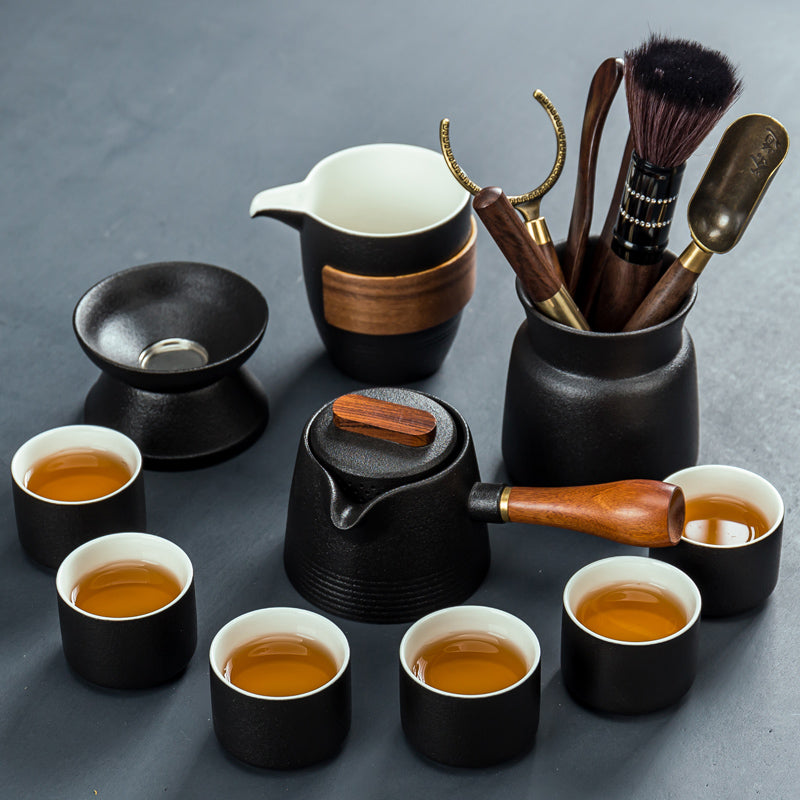 Vendor:Japanese Minoyaki Kung Fu Tea SetUmi Tea Sets
- Regular price
-
$104.98 USD - Regular price
-
$128.90 USD - Sale price
-
$104.98 USD
Quick view
-
Mountains And Birds Kutani-yaki Tea Set
 Vendor:Mountains And Birds Kutani-yaki Tea SetUmi Tea Sets
- Regular price
-
$109.98 USD - Regular price
-
$159.80 USD - Sale price
-
$109.98 USD
Quick view
-
Japanese Black Pottery Mountains Tea Set
 Vendor:Japanese Black Pottery Mountains Tea SetUmi Tea Sets
- Regular price
-
$128.98 USD - Regular price
-
$158.60 USD - Sale price
-
$128.98 USD
Quick view
-
Japanese Vintage Banko-yaki Tea Set
 Vendor:Japanese Vintage Banko-yaki Tea SetUmi Tea Sets
- Regular price
-
$106.92 USD - Regular price
-
$135.60 USD - Sale price
-
$106.92 USD
Quick view


What is a Japanese Tea Set?
A Japanese tea set is a set of dedicated tea ware designed to match Japanese tea-drinking habits and tea ceremony procedures. It mainly falls into two categories: tea ware for daily tea brewing and tea ware for tea ceremony rituals. The core differences between a Japanese tea set and Chinese tea set lie in design logic, capacity, and method of use. A Japanese tea set avoids unnecessary decoration and focuses on practicality and suitability. Many people easily confuse a Japanese tea set with Chinese tea set, but in fact, the differences are very obvious in the details, and with long-term experience, it is easy to tell them apart.
For daily use, a Japanese tea set is built around two core ideas: "one-handed operation" and "small-capacity + slow drinking." This is closely related to traditional Japanese tea-drinking habits. In Japan, tea is more often enjoyed alone or in small gatherings of two to three people, rather than in the larger group settings common in China. The spout and handle are usually set at a right angle, allowing the user to hold the handle with one hand and pour out the last drop of tea easily. This helps prevent tea from remaining in the teapot, which could otherwise lead to affect flavor. Cup capacity is also highly standardized, usually between 80 and 160 ml, so the tea can be finished quickly before it cools and turns astringent. This is especially suitable for lightly fermented teas.
There are many different Japanese tea sets. Although there are many on the market, over 95% of them are made of two basic materials, ceramic or porcelain. Of course, there are silver, iron, and lacquer ware tea sets made, but they are few and of considerable value and much trouble to care for.
The core characteristic of a Japanese tea set is "adaptability." For example, teapot capacity is designed according to the brewing needs of common teas. A teapot of 180-220 ml is ideal for brewing 3-5 g of tea leaves, and when paired with 80-100 ml tea cups, it helps keep the strength of each cup even. In addition, the glaze of a Japanese tea set is usually matte or semi-matte, unlike the glossy glaze often seen on Chinese tea set. This reduces reflection, prevents fingerprint marks, and makes the set easier to maintain. Another often overlooked detail is that the base of a Japanese tea set is usually flatter and slightly heavier, making it less likely to tip over on a tea table. This also supports one-handed pouring, since the teapot remains stable instead of wobbling due to an uneven center of gravity. By contrast, Chinese tea set often has a rounded or curved base and a higher center of gravity, which is better suited to two-handed use.
How Many Firing Styles are there for a Japanese Tea Set?
There are nine styles of Japanese tea sets classified according to firing styles of tea sets from various kilns around Japan. The Japanese tea sets are categorized based on geography, materials and kiln firing techniques, and each has unique textures and uses. Currently, there are nine mainstream styles available for everyday use.
1. Bizen-yaki (備前焼)
Bizen-yaki is one of the oldest firing styles in Japan, originating in Bizen City, Okayama Prefecture, with a history of more than 1,300 years. It is currently the only Japanese high-temperature style that remains completely unglazed. Its core feature is "natural surface patterns without glaze," making every piece unique. It uses local red clay with an iron content of 8% to 10%, which is hard, breathable, and highly suitable for making ceramic tea ware.
Its firing process is very strict. It is wood-fired at 1200-1300°C for more than seven days, and the flame must be manually controlled so the fire fully interacts with the clay. Because no glaze is applied, the clay's natural color and texture remain visible, while the fire creates brown, black, and red natural markings. No two pieces are exactly the same.
According to our practical testing, Bizen-yaki has a water absorption rate of 6% to 8%, which allows it to absorb some unwanted notes from the tea liquor and produce a fuller taste. Because the clay is rich in iron, tea polyphenols gradually react with the surface over time, forming a warm patina and increasing the luster of the pot. Bizen-yaki pieces are heavy, with a single Kyusu Teapot weighing about 350-400 g. The rounded spout pours smoothly without dripping, making it suitable for sencha and hojicha that require higher-temperature brewing.
Maintenance is simple: rinse with clean water and air dry naturally, and avoid detergent so as not to damage the clay's breathability.

2. Kutani-yaki (九谷焼)
Kutani-yaki originated in Kutani, Ishikawa Prefecture, in the mid-17th century. It is a representative style of Japanese porcelain tea set, known for hand-painted decoration with gold accents and vivid colors. It combines practicality with decorative appeal and is one of the most popular styles on the market, especially as a gift. It uses fine local porcelain clay, which has a fine texture and a thin, light body. It is fired at 1300-1400°C, and has a water absorption rate below 0.5%.
Its signature technique is hand painting with mineral pigments and gold powder, often featuring flowers, birds, landscapes, and figures. The pattern features vibrant colors, delicate details, and a strong three-dimensional effect. Common motifs include cherry blossoms, Mount Fuji, cranes, and the "pine, bamboo, and plum" trio. After painting by hand, the piece is glazed and fired multiple times so the decoration bonds firmly to the surface. "Kinrande," the technique of outlining motifs with gold, is one of its classic features. The gold lines outlining the edges of the design give it a high-end and sophisticated look, and are also a hallmark of high-end Kutani teaware.
The glaze is smooth and non-porous, so it does not absorb tea aroma and preserves the fresh taste of premium green teas such as gyokuro and kabusecha. A single teapot usually weighs around 180-220 g, making it light and easy to use with one hand, though it should be handled carefully. Its glaze is prone to scratching, so it should be wiped with a soft tea towel and protected from sudden temperature changes.
In terms of maintenance, the glaze of Kutani teaware is prone to scratches and should not be cleaned with a hard-bristled brush. It is recommended to wipe it with a soft tea towel and avoid contact with high temperature and sudden cooling to prevent the glaze from cracking.

3. Banko-yaki (萬古焼)
Banko-yaki is a type of Japanese ceramic tea set which originated in the production area of Nagoya City in Aichi Prefecture. The production of Banko-yaki tea set is about 400 years old. Banko-yaki uses purple clay which contains 10% to 12% iron content. The body is purplish-brown and has good texture, breathability and absorption rate of 7% to 9%.
It is usually wood-fired at 1100-1200°C. During firing, the iron oxidizes fully and creates a natural color. The surface is generally matte, with slight granularity, giving it a simple and rustic appearance. Most pieces are Kyusu teapot forms with capacities of 150-200 ml, clean lines, right-angle handles for one-handed use, and built-in tea strainer to prevent leaf blockage.
Purple clay of banko-yaki pot can react with tannins in tea to reduce astringency and increase sweetness. In our test, sencha brewed in Banko-yaki tastes about 15% sweeter than brewed in ordinary ceramic teapot. Banko-yaki teapot can keep tea warm long time. Even after poured 95°C water in it for 30 minutes, it still can get warm water. Banko-yaki teapot is very durable and easy to keep. It only needs to rinse with water and let it dry in air. The surface of the clay will get a natural patina over time.

4. Tokoname-yaki (常滑焼)
Tokoname-yaki comes from Tokoname City in Aichi Prefecture and is one of Japan's high-output ceramic tea ware styles. It is centered on the Kyusu teapot and is suitable for daily home use and beginners. It uses local red clay with an iron content of 9% to 11%, and after firing it appears red or dark red, with a warm hand feel.
It can be either wood-fired or electric-fired. Mass-produced pieces are usually electric-fired and therefore more affordable, while handmade wood-fired pieces are more textured and more expensive. The surface is usually semi-matte, with fine texture and occasional simple decoration.
According to our practical testing, Tokoname-yaki enhances the strength of aroma, especially when brewing genmaicha and hojicha. Its moderate absorption rate of 6% to 8% helps remove unwanted notes without over-absorbing aroma. Please wash only with pure water. Do not wash with detergent. Please be sure not to leave tea inside for a long time as it may change the color of the Tokoname-yaki clay.

5. Kiyomizu-yaki (清水焼)
Kiyomizu-yaki is a style of Japanese porcelain tea set made in the area surrounding Kiyomizu Temple in Kyoto. It is one of the most well-known and beloved of all the Japanese tea set styles and was first produced in the 17th century. Extremely simple and minimalistic, Kiyomizu-yaki is suitable for use in the traditional Japanese tea ceremony, or as part of your luxury hotel or restaurant. Fine local clay is used and fired at a high temperature of 1300-1400°C with a water absorption rate of less than 0.5%.
In contrast to many other forms of pottery, Kiyomizu-yaki tends to be a fairly monochromatic form of ceramics. While many of the pieces are unadorned, some of the higher end Kiyomizu-yaki ceramics may include hand-painted lines or patterns. Most Kiyomizu-yaki pieces come in the form of Kyusu teapots, tea bowls, or yunomi cups.
According to our practical testing, a single tea bowl often weighs only 50-80 g. Because the glaze is non-porous, it preserves the refreshing taste of teas such as gyokuro and high-grade sencha and also makes the color of the tea easier to appreciate. Kiyomizu-yaki belongs to the mid-to-high-end range, but because it is thin and fragile, it must be handled gently, cleaned with a soft tea towel, and protected from sudden heating and cooling.

6. Minoyaki (美濃焼)
Minoyaki refers to the pottery which is made in Mino in Gifu Prefecture. It is the highest output of ceramic tea wares in Japan. With simple designs and affordable prices, it is the most mainstream style of tea ware that people use on a daily basis. The most common form of minoyaki is made from ceramic and is rather thick, making it very easy to take care of and durable. However, the porcelain forms are much finer and more aesthetically pleasing.
Most Minoyaki is electric-fired at 1100-1300°C, which keeps production costs lower. Styles range from simple solid colors to light hand-painted motifs such as flowers, birds, or geometric designs, matching modern interiors well. Tea sets can come in many configurations, such as one teapot with four cups, six cups, or ten cups.
According to our practical testing, Minoyaki is quite durable, with an absorption rate of 5% to 7%, making it suitable for sencha and genmaicha. The Kyusu teapot is designed simply, feels comfortable in the hand, and usually includes a built-in strainer for easy filtering and cleaning. Ceramic versions only need rinsing, while porcelain versions should be handled more carefully.

7. Mikawachi-yaki (三川內焼)
Mikawachi-yaki has about 400 years of history and is described as a mid-to-high-end traditional Japanese tea set style within Japanese ceramic tea set. Its core characteristics are delicate painted decoration and refined texture, combining practical use with collectible value. It uses fine clay with relatively high iron content and has an absorption rate of 6%-8%. The firing temperature is 1200-1300℃, resulting in a hard ceramic body.
Its signature technique is detailed hand painting with mineral pigments, usually depicting flowers, birds, landscapes, and figures. The surface is usually semi-matte with a subtle texture, giving it a classic and elegant appearance. The tea ware feels stable in the hand, with a single teapot weighing around 320-380 g, and it pours smoothly. The clay absorbs some unwanted notes from tea and improves body, especially for sencha and hojicha. Because handmade pieces vary slightly in decoration, each piece is unique.

8. Satsuma-yaki (薩摩焼)
Satsuma-yaki originated in the Satsuma region of Kagoshima Prefecture in the 17th century. It is one of the most luxurious-looking styles within the Japanese tea set category and is valued both for use and for collecting. It is often chosen as a premium gift. It uses fine porcelain clay, has a thin dense body, and is fired at 1300-1400°C with a water absorption rate below 0.5%.
Its key craft is richly painted Kinrande decoration with gold powder and mineral pigments. Common motifs include flowers, birds, landscapes, and figures, all outlined with fine gold lines. Some premium pieces even incorporate inlay work with gold, silver, or pearls. A single teapot generally weighs about 180-250 g and preserves the fresh taste of premium teas (Gyokuro, premium sencha) because the glaze is smooth and non-absorbent. Since production is limited and handmade pieces are rare, Satsuma-yaki is scarce and expensive. It should be protected carefully from scratching, impact, and sudden temperature changes.

9. Awata-yaki (粟田焼)
Awata-yaki originated in the Awataguchi area on the eastern edge of central Kyoto. It is known for hand-painted natural motifs using mineral and plant-based pigments, and it represents a fresh and elegant style of Japanese porcelain tea set. It uses fine local porcelain clay, has a thin body, is fired at 1300-1400°C, and has a water absorption rate below 0.5%.
The designs of these are mainly natural; cherry blossoms, maple leaves and bamboo are typical motifs. The colors are pastel or bright, but traditionally presented as Japanese natural scenery views softly and delicately rendered. As they are made with natural pigments, the colors are typically subtle and long lasting.
These small tea cups feel light when you hold them in your hand and have a circular lip that feels comfortable against your lips. They weigh about 40 to 60 grams. The glaze is non porous and thus the tea keeps its fresh quality and you can distinctly see the bright green color of the gyokuro tea. Easy to clean, one has to be a bit careful because the thin teacup can break if it is dropped or if it is exposed to large temperature differences.

All 9 styles of Japanese pottery have their own qualities and uses. Bizen-yaki, Banko-yaki, and Tokoname-yaki can be used in daily personal life because they are strong and easy to clean. Other types like Kutani-yaki, Kiyomizu-yaki, and Awata-yaki are more suitable for having guests over for tea or for displaying rare teas. Styles like Mikawachi-yaki and Satsuma-yaki are better suited for collection or as gifts. Minoyaki however is good for everyday use with very good cost performance.
What is the Difference Between a Traditional Japanese Tea Set and a Vintage Japanese Tea Set?
Contrary to popular belief a traditional Japanese tea set is very different to a vintage Japanese tea set. They are very different in terms of how they were made, what they were designed to be used for, details and price. They are not intended for the same purpose.
Traditional Japanese Tea Set and Vintage Japanese Tea Set have different positional awareness. Traditional Japanese Tea Set follows old Japanese craft methods, pursuit of ritual feeling and traditional workmanship. As a result, they are mainly used for Japanese tea ceremony. Vintage Japanese Tea Set is a modern reproduction of the old Japanese Tea Ware, following a style of everyday use. They are very suitable for modern home and modern lifestyle, which are the mainstream choice of mass market consumers.
1. Different Craft Standards
A traditional Japanese tea set strictly follows traditional firing methods without modern industrial modification. From raw material selection and shaping to glazing and firing, each step uses traditional techniques. Tea-ceremony-grade traditional Japanese tea set pieces are handmade by artisans and do not follow standardized mass-production specifications. Slight differences in body thickness, glaze texture, and size are normal and are considered part of the beauty of handmade work.
Traditional pieces are often wood-fired, which means long firing times, difficult heat control, low yield, and high cost. According to our practical testing that some traditional Bizen-yaki and Mikawachi-yaki pieces have success rates of only about 60%, which is one reason they are expensive. Traditional pieces also avoid modern chemical additives in glaze and use natural clay and mineral materials.
A vintage Japanese tea set, by contrast, is produced through industrialized processes such as electric or gas firing. Production is faster, heat is easier to control, yield is higher, and cost is lower. While it retains the look of older Japanese tea ware, it usually adds practical modern improvements such as built-in strainers, rounded edges, and adjusted capacities. Machine-formed bodies and partially hand-applied coloring are common, and the pieces are more regular in size and finish, they are very less defects.
2. Different Use Scenarios
We hold that a traditional Japanese tea set is primarily intended for Japanese tea ceremony or very formal tea practice, and are not suitable for everyday use due to the low frequency of use associated with Japanese tea ceremony. For centuries Japanese tea ceremony has placed very strict demands on the size, form and workmanship of the traditional Japanese tea set, and all designs have been orientated towards this beautiful art form. For example, the size of the bowl and the shape of the vessel are designed to suit whisking and serving procedures, so using them for ordinary daily brewing can be cumbersome and does not fully show their value.
We were using a traditional Bizen tea bowl for daily sencha felt inconvenient because the capacity was too small and there was no built-in strainer, so leaf particles easily entered the mouth. The maintenance of it is also particularly laborious, since the silver tea bowl must be constantly polished in order to prevent it from oxidising and darkening.
This vintage Japanese tea set is perfect for use in your home or for hospitality. Made of solid Japanese materials, this teapot and tea set is modern and will match any kitchen or tea space beautifully. It typically includes built-in strainers to prevent clogging, rounded handles and rims for more comfortable use, and capacities of about 180-220 ml to suit two to five people. It is easier to use and easier to clean.
3. Different Design Details
A traditional Japanese tea set does not include a built-in tea strainer and usually requires a separate filter. This is because it is mainly used in tea ceremony, where powdered tea is more common and filtering is unnecessary. In daily brewing, however, a separate filter is often needed. Often in plain colors or natural textures such as the fire marks of Bizen-yaki or the plain glaze of Kiyomizu-yaki.
A vintage Japanese tea set generally comes with a built-in 360° stainless-steel tea filter with evenly distributed holes, which filters out tea fragments effectively and makes brewing more convenient. Handles and rims are rounded for comfort, and some handles also include anti-slip design. Capacities have also been modernized. For example, a traditional kyusu teapot is often under 150 ml and intended for one person, while a vintage japanese tea set version may be adjusted to 180-220 ml for two or three people. It keeps the vintage visual style while adding modern design details such as simple hand-painted decoration and anti-slip bases.
4. Different Price Ranges
A traditional Japanese tea set is expensive because it relies on old craft methods, handmade production, low output, high cost, and difficult firing. It mainly appeals to collectors and tea ceremony enthusiasts. A Japanese artisan may spend one to two months making a single traditional Bizen tea set, from material selection and forming to firing, which explains the high price. In many cases, the collection value is far higher than the practical value.
A vintage Japanese tea set is relatively affordable and better suited to ordinary daily use. Because it is industrially produced in higher quantities with simpler craftsmanship, it offers a lower price and better cost performance.
What is a Japanese Tea Ceremony Set?
Japanese tea ceremony set for Japanese tea ceremonies which is a completely different item from the Japanese tea set. The items in the tea ceremony set are all unique and necessary for the Japanese tea ceremony and should not be confused with the items used for brewing tea in everyday settings. Common items found in a Japanese tea ceremony set include the tea bowl, tea scoop, whisk, tea caddy, water pitcher, brazier, kettle, tea towel and kettle mat.

1. Core Utensils: Functions and Specifications
The Tea Bowl is the core utensil. It is used to hold the tea and is divided into bowls for strong tea and bowls for light tea. The Bowls for strong tea hold 100-120ml and are deep with a small mouth. The Bowls for light tea hold 120-150ml and are shallow with a wide mouth. Tea Bowls are normally made of ceramic or porcelain and come in many different styles. The most known styles of Tea Bowls, Bizen-yaki, Kiyomizu-yaki and Kutani-yaki are all handmade with a matte glaze and have a natural earthy appearance with fine patterns.
The Tea Scoop is used to measure tea powder. It is usually made of bamboo, though some premium versions use wood or ivory. It is normally 18-20 cm long, with an oval scoop head sized to measure about 2 g of tea powder. The scoop is carefully polished so it does not scratch the bowl, and each one is handmade rather than mass produced.
The Whisk is used to mix tea powder with hot water into a fine and smooth tea. It is usually made of bamboo with 80-100 tines. The tines are fine, even, and free of burrs, and the handle is usually 15-18 cm long for comfortable whisking. The bamboo must be specially treated so it stays soft yet resilient and does not break easily. After use, it must be cleaned and dried promptly to prevent mildew.
The Tea Caddy stores tea powder and comes in versions for strong tea and light tea. It is usually made of ceramic, porcelain, or lacquer ware, with a capacity of 50-100 g. Strong tea caddies are often round, while light tea caddies are often square, and both usually emphasize practicality through simple form and restrained decoration.
The Water Pitcher is a teapot accessory used to hold hot water for brewing tea before pouring it into the teapot. It is generally made of ceramic or porcelain and holds around 300-500 ml of liquid. It has a small spout for accurate pouring.
The Brazier is a small vessel used to heat the water for tea, it comes in both clay and iron versions. Braziers are small enough to be placed on a tea table and heat to a suitable temperature for tea making. They reach a temperature of around 80-90°C.
The Kettle holds 500-800ml of water and keeps water at the right temperature for longer making it a great addition for all session long ceremonies.
The Tea Towel is made from cotton and is a soft and absorbent textile garment that was typically used to wipe clean items such as the bowl and tea caddy after washing.
The Kettle Mat protects surfaces from scratches and heat marks. Available in cloth or bamboo.
2. Use Experience and Precautions
In actual use, a Japanese tea ceremony set requires a very complicated operating process and professional technique. For example, when making tea, you have to accurately scoop the right amount of Japanese tea powder into the bowl, pour the right amount of hot water into it and then rapidly whisk them up until the mixture is smooth and even. All of these movements require practice in order to develop the right amount of speed and force with the whisk. If not performed correctly, the finished matcha can be very uneven in texture and not taste as well as it could.
Using a Japanese tea ceremony set for daily tea brewing takes a great deal of time and does not make full use of the set's intended value. For example, most tea bowls intended for brewing sencha are too small for multiple sips of tea and really only intended for drinking matcha. The whisks, kettles, and tea bowls all require a lot of care and maintenance - from washing and drying the ball of the whisk before it begins to mold to keeping the kettle rust free to protecting delicate tea bowls from scratches and cracks.
For this reason, a Japanese tea ceremony set is not suitable for frequent daily use. It is more appropriate for tea ceremony, cultural display, or collecting. Ordinary consumers do not need to buy one for daily drinking. If you want to experience the tea ceremony process, we recommend starting with a Japanese tea service set intended for daily home use, which is cheaper and more suitable for beginners.
What does a Japanese Tea Service Set Include?
A Japanese tea service set can be divided into two categories: daily home-use sets and tea-ceremony-only sets. According to our practical testing, around 90% of sets currently on the market are daily home-use sets, with standardized configurations that fit mainstream needs. Tea-ceremony-only sets are more complex and are rarely used by ordinary consumers.
1. Daily Home-Use Japanese Tea Service Set
The daily home-use Japanese tea service set is designed around practicality, convenience, and simplicity. It is mainly used for everyday tea brewing and serving guests, fitting modern tea-drinking habits. According to the number of users and the setting, the main configurations are one teapot with four tea cups, one teapot with six tea cups, and one teapot with ten tea cups. Among them, one teapot with four cups is considered the most practical for one or two people, while one teapot with ten cups is better for family hospitality or small gatherings.
The core configuration usually includes one kyusu teapot and four to ten yunomi tea cups. Some premium versions also include coasters and a tea holder, while a few sets include a tea towel and tea strainer if the Kyusu Teapot does not have a built-in strainer.
The kyusu teapot is the core brewing vessel of a Japanese tea service set. It is usually 180-220 ml, suitable for brewing 3-5 g of tea leaves. When paired with yunomi tea cup pieces of 80-160 ml, it helps ensure even tea strength in each cup. Its main design features are the side handle teapot at a right angle for one-handed use, a built-in 360° strainer to prevent clogging, and a flat base for stability on the tea table. In mid-range tea sets, the Kyusu Teapot is usually made of ceramic, often Minoyaki or Banko-yaki. Premium tea sets may use porcelain, such as Kutani-yaki or Kiyomizu-yaki, while a few very expensive sets may use silver or iron, though these are harder to maintain and not ideal for daily use.
The yunomi cup is used to hold the tea liquor. Individual cup capacity is usually 80-160 ml, though the ideal size depends on the type of tea. For premium green teas such as gyokuro and kabusecha, smaller cups of 80-100 ml are better because they preserve freshness more effectively. For sencha and genmaicha, 120-160 ml is more comfortable for daily drinking. The material of the yunomi cup usually matches that of the kyusu teapot: ceramic versions feel more solid in the hand, while porcelain versions feel lighter, and the rim is smoothed to prevent discomfort while drinking.
Additional accessories may include a coaster for placing the yunomi cup and preventing drips on the tea table, a tea holder for presenting tea leaves, and a tea towel for wiping tea stains from the teapot and cups. Typical specifications are as follows: a one-pot four-cup set usually includes a 180-200 ml kyusu teapot and 80-100 ml yunomi cup pieces for one or two people; a one-teapot six-cup set usually includes a 200-220 ml kyusu teapot and 100-120 ml cups for three to four people; and a one-teapot ten-cup set usually includes a 220-250 ml kyusu teapot and 120-160 ml cups for five to eight people.
2. Tea Ceremony Only Japanese Tea Service Set
The tea-ceremony-only Japanese tea service set is designed entirely around the powdered tea preparation process and does not include a teapot. Its configuration is complex and its craftsmanship standards are strict. A standard set includes the tea bowl, tea scoop, whisk, tea caddy, water pitcher, brazier, kettle, tea towel, and kettle mat already described above. It is not suitable for daily tea brewing because the process is complicated and the maintenance burden is high. It is best suited for tea ceremony, cultural display, or collecting. Tea enthusiasts may choose either a daily home-use Japanese tea service set or a tea-ceremony-only Japanese tea service set depending on their needs.
How to Select a Japanese Tea Set?
For most consumers, we recommend choosing a daily-use Japanese tea service set directly instead of pursuing a tea-ceremony-only model, which may be unnecessary and wasteful for everyday use. When you buying it, a one-teapot four-cup configuration should be the first choice. It is the most practical option, does not take up much space, is easy to clean, and is enough for daily tea drinking. If you often serve guests, then a one-teapot six-cup or one-teapot ten-cup configuration will be more suitable.

In terms of material, ceramic is the better choice for everyday use. Styles such as Minoyaki, Banko-yaki, and Tokoname-yaki are durable, easier to maintain, and offer good value for money. If you care more about appearance and flavor clarity, then porcelain is a better option. Styles such as Kutani-yaki and Kiyomizu-yaki are more suitable for enjoying premium green teas.
It is also important to pay attention to the details of the set when you buying. For example, check whether the handle of the kyusu teapot feels comfortable in the hand and whether the rim of the cup has been polished smooth. These details directly affect the overall experience of using a Japanese tea set. It is always recommended to buy from a reliable and right channel to avoid imitations. Poor-quality imitations often use inferior materials, perform badly in daily use, and may even come with safety risks.
What is the Difference Between a Japanese Ceramic Tea Set and a Japanese Porcelain Tea Set?
There are two types of the Japanese tea sets that are being widely circulated in the market. Over 95% of the Japanese tea set in the market are made of Japanese ceramic tea set and Japanese porcelain tea set. Many people may think that the Japanese ceramic tea set and Japanese porcelain tea set is the same because the word of “Porcelain” and “Ceramic” are the same but in fact they are very different. In terms of raw material, firing process, performance, user experience and ease of cleaning, the two products are completely different. Based on our long time of using the two type of products and comparison of hands on experience, we will explain in simple words for everyone’s reference.
1. Different Materials
A Japanese ceramic tea set belongs to pottery and is made from clay. This clay is relatively coarse, and usually has a higher iron content, generally between 5% and 12%. Different kilns use different clays. For example, the purple clay used in Banko-yaki contains as much as 10%-12% iron, while the red clay used in Bizen-yaki contains about 8%-10%. Because the clay particles are larger and the structure is looser, small pores remain in the body even after firing. This is why a Japanese ceramic tea set has natural breathability.

A Japanese porcelain tea set, by contrast, is made from porcelain clay. Porcelain clay is finer, and has a much lower iron content, usually between 1% and 3%. In some cases, such as Kutani-yaki and Kiyomizu-yaki, the iron content is below 2%. The particles are small and dense, and after high-temperature firing, the body becomes hard, smooth, and almost completely pore-free.

A simple practical way to tell the difference is by touch. A Japanese ceramic tea set feels rougher, with a visible grain and a more solid hand feel. A Japanese porcelain tea set feels finer, smoother, and lighter. In addition, the body color is usually different. Ceramic bodies are often brown, purplish-brown, or dark red because of their higher iron content, while porcelain bodies are usually white or off-white, with a cleaner and more delicate appearance.
2. Different Firing Process and Temperature
Japanese ceramic tea sets are fired at a lower temperature (around 1100-1200°C or even higher at 1300°C when wood-fired), and only need to be fired for 1 to 3 days. The process is simple and mostly done by wood firing or electric firing. The iron in the clay oxidizes to its most natural state and creates natural colours and textures. The glaze is matte or semi-matte with little to no shine.
Japanese porcelain tea sets have undergone a more complex process than other porcelains. Having fired at a high temperature of around 1300-1400°C (some of the finest examples firing at 1500°C). Typically this process can take between 3-7 days, unlike other porcelains that can be fired within a day. Japanese porcelain is usually fired in an electric or gas kiln, allowing any impurities in the original porcelain clay body to be burned away completely. The result is a dense body, quite different to less refined porcelains. Typically the glaze is applied prior to the final firing, but often this is not a single event with many pieces having multiple firings to achieve the perfect finish. Ultimately this process results in a much smoother, finer and more polished finish than other porcelains.
Examine the item closely and listen to it carefully by tapping it against other items. The sound and the appearance of the glaze will differ between a Japanese ceramic tea set and a Japanese porcelain tea set. The ceramic tea set will sound dull and heavy with little echo due to the pores of the body. On the other hand, the porcelain tea set will sound bright and sharp with marked echo. The glaze will also look different. The glaze on ceramic items are slightly rough to the touch and have an earthy tone and texture. In contrast, porcelain items have a smooth appearance with a soft glazed surface.
3. Different Water Absorption
There is a difference in water absorption between Japanese ceramic tea sets and Japanese porcelain tea sets. All Japanese ceramic tea sets have water absorption rate of 5% to 10%. Water absorption rate differs depending on the kiln. Each kiln has its own characteristics. Also, even in the same region, there are differences in water absorption rate.
A Japanese ceramic tea set made by using Bizen-yaki firing method has an average of 6%-8% water absorption rate. Banko-yaki is 7%-9% and Tokoname-yaki is 6%-8%. The fine pores of the body of the tea set allow water to slowly permeate into the surface. The area where water has permeated will become damp after a while.
A Japanese porcelain tea set has a water absorption rate below 0.5% and is almost non-absorbent. Because the body is dense and pore-free, water simply stays on the surface as a bead and does not penetrate, even after a long time.
A simple test is to place a drop of water on the unglazed part of the body, usually at the bottom of the teapot. If the water slowly seeps in and the body becomes damp, it is ceramic. If the water remains as a bead and does not penetrate, it is porcelain. This is a very direct method and does not require any special tools.
4. Different Weight and Texture
A Japanese ceramic tea set usually has a thicker and heavier body with lower density. A single kyusu teapot often weighs around 300-400 g. It feels steady and substantial in the hand, especially during one-handed use, and never feels too light. It is lovely to hold Japanese ceramic teapots during the colder seasons as there is a slight warmth in the body of the teapot against your hand. The surface is usually either matte or semi-matte with a natural finish with texture. The more you use the ceramics, the warmer and softer to the touch it becomes and develops a lovely patina.
A Japanese porcelain tea set is thinner, lighter in body with a higher density, harder and smother than Japanese porcelain tea set. A medium size kyusu usually weighs around 150-200 g and feels light enough for hot season use. It has a fine glossy smooth surface with no graininess and a delicate and elegant glaze with soft refraction. It also has a certain degree of translucency because of the thin body.
To compare the two materials it is worth comparing two similar sized pots side by side. The ceramic piece will feel heavy and substantial to hold compared to the porcelain piece which will feel light, fine and even delicate. Looking at the surface of the work is also useful to distinguish between the two. Ceramic pieces have a rough, mate finish whereas porcelain pieces have a glassy, glossy finish. Looking at the body of the work under normal lighting will also reveal a slight translucency in the porcelain compared to the ceramic.
5. Different Maintenance Difficulty
A Japanese ceramic tea set is generally easier to maintain. It is more resistant to bumps and less likely to break. Even if it is accidentally dropped, it may only chip slightly instead of shattering immediately. Its glaze is relatively forgiving, and tea stains can usually be removed through normal cleaning. After each use, it is enough to rinse it with clean water and let it dry naturally. It is better to avoid detergent, as detergent may affect the breathability of the clay. One thing to keep in mind is that although ceramic is more durable, strong tea should not be left inside for too long, otherwise tea stains may seep into the pores and become difficult to remove.
A Japanese porcelain tea set is more difficult to maintain. The body is thinner and more fragile, so it is more easily damaged by impact. Even a minor collision may scratch the glaze or damage the body, and if dropped, it is more likely to break completely. Because the surface is smooth and refined, it is also easier to leave scratches, so it should not be cleaned with a hard brush. A soft towel is the safer choice. It is also important to avoid sudden temperature changes. For example, a teapot that has just been filled with boiling water should not be placed immediately on a very cold surface, otherwise the glaze may crack.
From a practical point of view, if you intend to use a Japanese tea set regularly, then a Japanese ceramic tea set is more practical and easier to care for than a beautiful handcrafted Japanese porcelain tea set. From an aesthetic and flavour point of view, however, a Japanese porcelain tea set is best when appearance and clarity of taste are of highest importance, and only the finest teas will be poured from the tea set. However, due consideration must be given to the delicate handling of this beautiful tea ware.
What Tea is a Japanese Ceramic Tea Set Suitable for, and What Tea is a Japanese Porcelain Tea Set Suitable for?
The two types suit completely different teas because the material directly affects the taste of the brewed tea. According to our practical testing.

A Japanese ceramic tea set is suitable for sencha, hojicha, genmaicha, and bancha. This is because the clay is rich in iron and can react with tannins in the tea, reducing astringency and increasing sweetness. Sencha brewed in a Japanese ceramic tea set showed about a 15% increase in sweetness. The body also retains heat well, making it suitable for brewing these teas at 90-100°C, and its moderate absorbency can remove some unwanted notes and create a fuller taste.
A Japanese porcelain tea set is more suitable for gyokuro, kabusecha, and high-grade sencha. Because it is non-absorbent, it does not retain aroma or tea flavor from previous brews and preserves the fresh character of premium green tea more completely. Its thinner body also dissipates heat faster, making it better suited to the lower brewing temperatures of 80-90°C needed for gyokuro. In addition, its smooth, non-porous glaze leaves no tea stains and is easy to clean. According to our practical testing, gyokuro brewed in a Japanese porcelain tea set retained about 30% more aroma than gyokuro brewed in ceramic tea ware.
If you use your tea set every day, a Japanese ceramic tea set will keep its shape and color better than porcelain. If you want to appreciate the beauty of your tea set and the precise flavors it produces, however, a Japanese porcelain tea set is more suitable, even though it is more delicate and requires more care.
How to Identify an Authentic Japanese Tea Set?
Identifying an Authentic Japanese tea set does not require professional tools. It suggests 3 practical steps, these 3 steps will help you avoid counterfeits:

First, check the mark on the base. An authentic Japanese tea set usually carries the Japanese kiln name, place of origin, or artisan signature in Japanese characters. Styles such as Kutani-yaki and Tokoname-yaki often have their own recognizable marks. Blurred printing or Chinese markings are warning signs, and imitations often have blank bases or low-quality English printing instead.
Second, do a water absorption test. For ceramic pieces, a drop of water that slowly penetrates over about ten seconds is treated that as a sign of authenticity, while water that penetrates very quickly is treated as a sign of imitation. For porcelain: If water does not form beads and instead penetrates then suspicious is recorded.
Third, examine the glaze workmanship. The workmanship on a well handmade piece is so slight that it is even and smooth with no bubbles or tears. This is completely different from reproductions which have rough particles, bubbles, glaze runs, blurry printed designs and lack any signs of handmade construction.
Where to Buy an Authentic Japanese Tea Set?
If you want to buy an Authentic Japanese tea set of truly good quality, the key is to avoid low-priced imitation sellers and choose a reliable store that specializes in this category. For tea lovers shopping across borders, there is no need to rely on overseas agents, search through small offline stores, or pay extra sourcing fees and high international shipping costs. We are a professional cross-border independent store that focuses on the best Japanese tea set category can make the process much easier. Umi Tea Sets is a strong option for this purpose. Umi Tea Sets offering a convenient one-stop destination for buying, collecting, and using a Japanese tea set for different needs.
The main reason to choose us is that it performs well in product range, quality, value, and shopping experience, which matches what you usually look for when searching for an Authentic Japanese tea set.
First, we have a variety of Japanese tea sets created with different materials and textures, such as rustic black pottery, metallic luster of gilded iron glaze and glossy red pottery with silver glaze. There are Japanese tea service sets for everyday tea drinking and Japanese tea ceremony sets for traditional rituals. Japanese tea service sets are designed for family hospitality. In addition to Japanese tea sets meant for use as part of hospitality for guests in your home, we have a number of items that would be great as tea lovers' collectibles or as gifts for other tea lovers. Browse our Japanese tea sets above.
Second, these tea sets are very nice to display as well. The products are designed with the aesthetic of Japanese traditional craft in mind and express the serene beauty of Japanese tea ware. Many of the designs still maintain the natural handmade textures and expressions of the surfaces. Not only the designs of the tea ware but also the choice of clay and glaze, the firing and the delicate decorative accents have been given greater consideration in relation to traditional Japanese standards rather than the production standards of mass produced and very watered down imitation products that you can find in the souvenir shops. For the buyer looking for the real article these items far exceed the price of the cheapest item you can find online.
Third, the value is more appealing because there is no unnecessary channel markup. Prices are clearly listed on the site, so you do not have to deal with the extra costs often added by overseas shopping agents or niche offline shops. That makes it easier to buy an authentic Japanese tea set at a more reasonable price. Whether you are a beginner looking for your first Japanese tea set, or a more experienced tea lover hoping to upgrade to a better piece, there are options across different budgets.
It is easy to navigate for a beginner to our site. The site has been set out under material, style and how you intend to use the product. Therefore you can search for items such as Japanese ceramic tea sets and Japanese porcelain tea sets. You can also search for a traditional Japanese tea set and items such as a vintage Japanese tea set. If you want a Japanese ceramic tea set for frequent daily use, or a Japanese porcelain tea set for enjoying gyokuro or premium sencha, or even a vintage Japanese tea set to create a more distinctive tea table style, you can locate the right direction much faster without getting lost in a crowded product catalog.
Finally, the cross-border shopping experience is more convenient because we focused on the Japanese tea set category itself rather than operating as a general homeware platform. A specialized seller usually understands the craft, material, and use differences between different kinds of tea ware much better. This also makes it easier for international buyers to shop with more confidence. Instead of worrying about complicated shipping, uncertain quality, or weak after-sales support, you can complete the selection and delivery process in one place and enjoy a smoother experience overall.
For anyone asking where to buy the best and most authentic Japanese tea set, the answer is not simply to choose the most expensive product, but to choose a trustworthy specialist store with a strong product focus, clear category structure, and reliable quality standards. In that sense, Umi Tea Sets is a practical and worthwhile place to start.